Priority Management
Priorities help users quickly identify the urgency of leads, opportunities, and other records. Each priority level has a name, icon, and color that provide visual cues across list views, kanban boards, and detail pages.
Priority Management Overview
Priorities are configured in the relevant module settings:
- Admin > Lead Settings > Priorities tab
- Admin > Opportunity Settings > Priorities tab
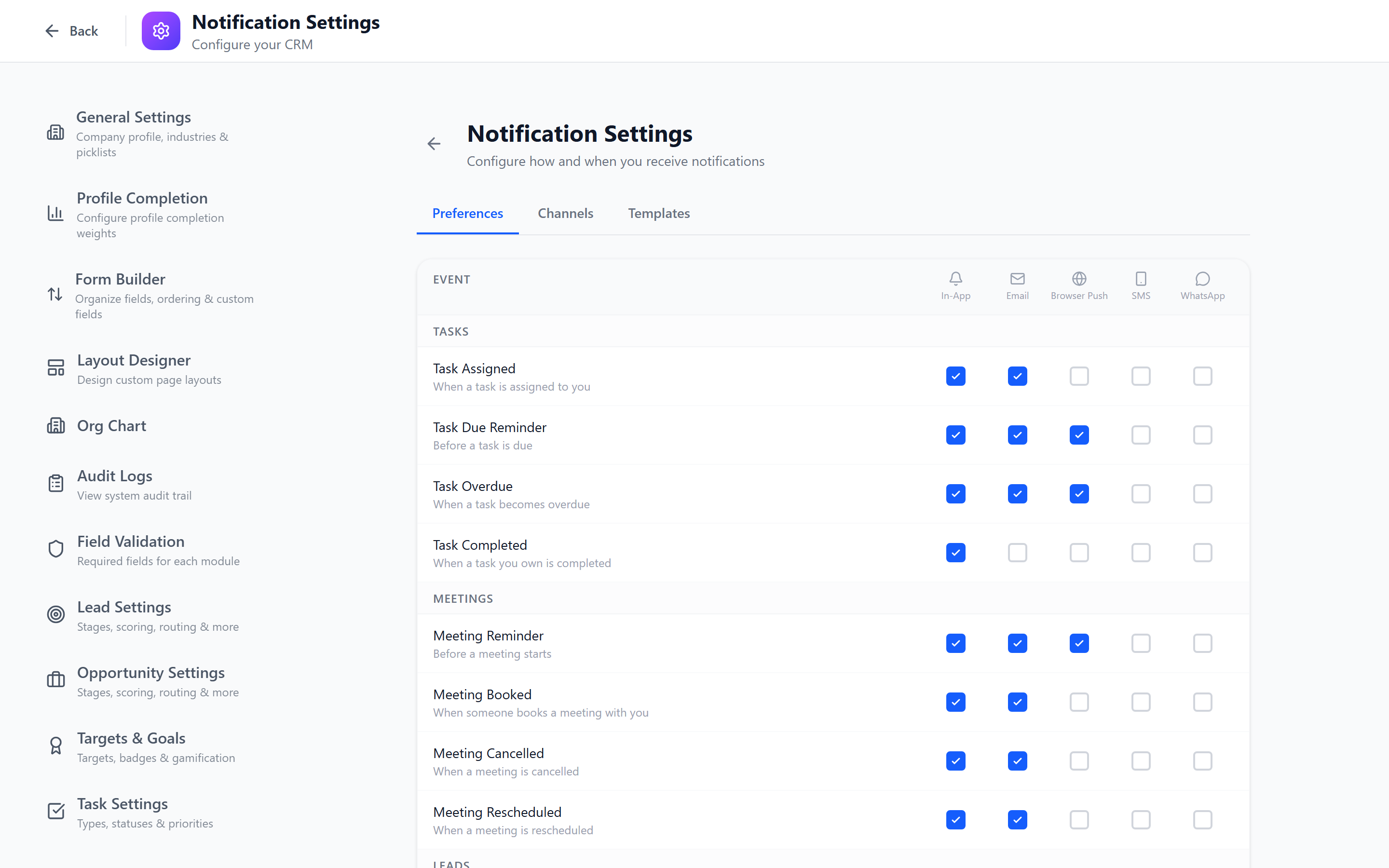
Creating Priorities
- Navigate to the module's settings and select the Priorities tab.
- Click Add Priority.
- Configure the priority:
- Name (required) — e.g., "Urgent", "High", "Medium", "Low", "None"
- Icon — select from the available icon set
- Color — select a color for visual identification
- Order — position in the priority list (1 = highest)
- Click Save.
Available Icons
| Icon | Name | Typical Use |
|---|---|---|
| 🔥 Flame | flame | Urgent / Critical — needs immediate attention |
| 🌡️ Thermometer | thermometer | High — important, act soon |
| ☀️ Sun | sun | Medium — standard priority |
| ❄️ Snowflake | snowflake | Low — handle when possible |
| ➖ Minus | minus | None — no priority assigned |
Use the standard icon set consistently across modules. Users quickly learn to associate "flame = urgent" and "snowflake = low priority" without reading the text.
Setting the Default Priority
One priority can be set as the default. When users create a new record without explicitly selecting a priority, the default is applied.
- Open the priority you want to set as default.
- Toggle the Default switch on.
- Save.
A sensible default is "Medium" or "None". Setting "Urgent" as the default defeats the purpose of prioritization — everything would start as urgent.
Editing Priorities
- Click on a priority in the list.
- Modify the name, icon, color, or order.
- Click Save.
Renaming a priority (e.g., "High" to "Critical") will update the display name everywhere. Existing records retain the updated name. Ensure the new name is communicated to your team.
Deleting Priorities
- Click the Delete button on a priority.
- If records use this priority, you will be prompted to select a replacement priority.
- Confirm the deletion.
Deleting a priority reassigns all records using it to the replacement priority you choose. This change is permanent and logged in the audit trail.
Impact on List Views and Cards
Priorities appear in several places across the UI:
| Surface | Display |
|---|---|
| List views | Priority column shows the icon and color |
| Kanban boards | Cards display the priority icon in the corner |
| Detail pages | Priority badge near the record title |
| Filters | Filter by priority in any list view |
| Reports | Group by or filter by priority |
Best Practices
- Keep it simple — 4-5 priority levels is optimal. More than that creates decision fatigue.
- Use distinct colors — red for urgent, orange for high, yellow for medium, blue for low, gray for none.
- Train your team — define what each priority means in concrete terms (e.g., "Urgent = respond within 1 hour").
- Set a neutral default — "Medium" or "None" prevents priority inflation.
- Review priority distribution — if 80% of records are "Urgent", the priority system is not being used correctly.
Next: Lead Settings — Configure lead scoring, routing, qualification, and more.